
Leadership Resilience Coaching vs. Executive Coaching:
Why the Difference Matters for Burned-Out Leaders
If you are researching coaching options, you have almost certainly run into both terms. They sound similar. They overlap in some ways. And the distinction is rarely explained clearly, which means many leaders invest in one when they actually need the other.
This article lays out exactly how leadership resilience coaching differs from standard executive coaching, who each approach is built for, and why the difference matters most for leaders who are already under sustained pressure.
What Executive Coaching Is Designed to Do
Executive coaching emerged as a discipline focused on developing leadership capability, typically through goal-setting, behavioral feedback, skill development, and career strategy. At its best, it helps leaders identify blind spots, improve how they communicate, navigate organizational politics, and prepare for larger roles.

The underlying assumption of most executive coaching is that the leader has the capacity to perform, and the work is about refining how they use that capacity. The focus is outward: how you lead others, how you show up in meetings, how you manage your team, how you position yourself for advancement.
For many leaders in stable conditions, that approach works well. If your fundamental functioning is intact and you need sharper skills or clearer strategy, executive coaching delivers.
But there is a category of leader for whom that approach misses the root problem entirely.
Where Executive Coaching Falls Short
The leaders who struggle most are not struggling because they lack skills or strategic clarity. They are struggling because the system underneath their performance has been quietly degrading for months, sometimes years.
Sustained pressure does not announce itself as a leadership problem. It shows up as decision fatigue that looks like indecisiveness. As emotional reactivity that looks like poor judgment. As disengagement that looks like strategic withdrawal. As health erosion that looks like low energy. None of these show up on a 360 review as "needs resilience coaching." They show up as things that executive coaching is already designed to fix, and so the coaching addresses the symptoms without ever reaching the cause.
The research is clear about what is actually happening at scale:

- 67% of American workers report feeling burned out
- Stress costs U.S. industry $300 billion per year (American Psychological Association)
- 60% of workplace absences are caused by psychological issues (Bureau of National Affairs)
- The top 10% of executives are almost universally optimists (Dr. Martin Seligman, University of Pennsylvania, 350,000-person study)
High-performing leaders are not immune to this. They are, in many ways, more vulnerable to it, because the drive and identity investment that makes them effective is the same thing that prevents them from recognizing how depleted they have become.
What Leadership Resilience Coaching Is Built to Do
Leadership resilience coaching starts one layer deeper than executive coaching. Before addressing skills, communication, or strategic positioning, it addresses the system that makes all of those sustainable: your capacity to perform under sustained pressure without degrading over time.
Leadership resilience coaching with Snowden McFall is built on the Leadership Resilience System, a four-element framework developed through 30+ years of direct work with high-performing leaders and grounded in the research documented in two published books: Stress Express! (2010) and Fired Up! The four elements are:
- Regulation: Managing your nervous system under sustained pressure. Staying grounded, avoiding reactive decisions, maintaining composure when the stakes are high.
- Recovery: Building the rest, restoration, and reset habits that allow sustained performance without grinding down the health and energy that make effective leadership possible.
- Focus: Clarity on priorities, protection of mental energy, and the capacity for strategic thinking that gets crowded out when everything feels urgent.
- Connection: The relational bonds, trust, communication, humor, and purpose that buffer stress and sustain motivation through extended difficulty.
When a leader is strong across all four elements, they perform well under pressure and recover quickly. When one or more elements have been depleted (which is the condition of most high-performing leaders who seek coaching), no amount of skills development produces lasting change. The foundation is not stable enough to hold it.
That is what leadership resilience coaching addresses first.
A Direct Comparison
| Dimension | Executive Coaching | Leadership Resilience Coaching |
|---|---|---|
| Starting point | Skills, behaviors, career goals | Resilience system: capacity to sustain performance |
| Core question | How can you lead better? | What is depleting your capacity to lead at all? |
| Assumption | Leader has capacity; needs to use it better | Leader's capacity may be compromised; needs to rebuild it first |
| Primary focus | Outward: how you lead others | Both: how you sustain yourself and how you lead others |
| Burnout treatment | Often not addressed directly | Central: prevention and recovery are core outcomes |
| Framework | Varies by coach, often behavioral or psychological | Structured: Regulation, Recovery, Focus, Connection |
| Results hold under pressure? | Sometimes; depends on stability of conditions | Yes, results are built to function under real pressure |
| Best for | Leaders who need skill refinement in stable conditions | Leaders under sustained pressure who need durable performance architecture |
The Integration: Why It Does Not Have to Be Either/Or
Leadership resilience coaching does not replace the work of executive coaching; it makes that work land. Skills training that sits on top of a depleted system does not stick. Communication development that happens while a leader is in chronic fight-or-flight produces inconsistent results. Strategic clarity that is built while decision fatigue is in play looks different six weeks later when conditions shift.
When the resilience foundation is in place, when Regulation, Recovery, Focus, and Connection are functioning, every other area of leadership development accelerates. The skills work actually holds. The behavioral changes persist under pressure. The strategic thinking is available when it is needed most.
This is why leadership resilience coaching integrates skills, communication, and executive presence work into the engagement, but always with the resilience system underneath it. It is not a softer version of executive coaching. It is a more complete one.
How to Know Which Approach You Actually Need
If you are genuinely unsure which type of coaching fits your situation right now, these questions are a useful starting point:

- Are you performing at a high level externally while feeling increasingly hollow or depleted internally?
- Has stress become the permanent condition of your role rather than a temporary season?
- Are you making decisions more slowly, second-guessing yourself more often, or feeling less certain than you used to?
- Have the habits like sleep, exercise, recovery, connection that used to sustain you quietly eroded?
- Do you feel "successful but not sustainable"?
If several of those resonate, resilience is the root issue, and addressing it first will make everything else more effective.
If you want a more structured starting point, the burnout self-assessment is adapted from the 7-question self-test in Stress Express!, developed in 2010, 15 years before corporate burnout entered the mainstream leadership conversation. It takes less than five minutes and gives you a clear read on where your resilience system stands right now.
Why the Methodology Matters
Most leadership coaching that now carries the word "resilience" is recent, assembled in response to the post-pandemic burnout conversation. The methodology behind Snowden McFall's approach is not.
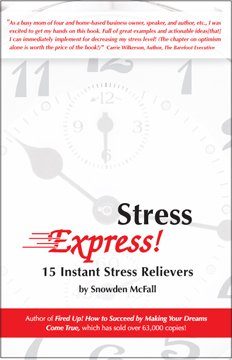
Stress Express! was published in 2010. The burnout self-assessment, the research statistics, and the framework for sustainable performance were developed and tested long before resilience became a business trend.The book has now gone throught its third edition, updated in 2025. Fired Up! traces the deeper origin: the same drive that makes a leader exceptional is exactly what puts them at burnout risk. That insight: stress as the flip side of being fully engaged, is the through-line that connects 30+ years of work.
The Leadership Resilience System is the organizational application of that depth. It is not a model assembled recently to meet market demand. It is the structured expression of what has been observed, tested, and refined across hundreds of individual leaders and organizational engagements over three decades.
That distinction, depth of IP versus recency of positioning, matters when you are choosing who to work with at a level of investment and personal exposure that executive coaching requires.
The Right Next Step
If you are a senior leader carrying significant responsibility and you have been wondering whether what you need is resilience support rather than, or in addition to, skills development, the most useful next step is a direct conversation.
Leadership resilience coaching with Snowden McFall is private, customized, and built on a tested framework. It is designed for leaders who are serious about measurable improvement in how they think, communicate, perform, and sustain that performance over time.
Contact Fired Up! to book a coaching conversation with Snowden McFall.
Tell us what you are navigating. We will tell you honestly whether this is the right fit, and if it is, we will build your leadership resilience plan from there.
Leadership resilience coaching with Snowden McFall is a private, structured engagement, not an open-ended conversation series. Each engagement begins with a confidential assessment of where your resilience system stands across the four elements: Regulation, Recovery, Focus, and Connection. That baseline shapes everything that follows.

Sessions are conducted one-on-one, typically by video or phone, and scheduled around the realities of an executive schedule. Engagements generally run three to six months, with the pace calibrated to the depth of the work. Some leaders come in with an acute situation- a role transition, a burnout recovery, a team that is under sustained stress. Others come in proactively, wanting durable performance architecture before a high-stakes stretch ahead.
The work is practical throughout. Every session produces specific actions, adjusted habits, or changed approaches that a leader can apply immediately. The framework is structured, but the engagement is built around what is actually happening in your leadership life, not a generic curriculum.
Investment is confidential and discussed directly. Engagements are designed for senior leaders who are serious about measurable outcomes and ready to work at the root level.